
Founded in China in 2017, Binance promised frictionless global trading powered by a next-generation decentralized ecosystem. But the reported $6.36 billion security breach on October 29, 2026 is one of the largest financial thefts in history. It has exposed the gap between the promise and the realities of the exchange’s structure.
The exchange claims it has drawn on its balance-sheet reserves and emergency funding mechanisms to cover roughly 90% of the missing capital, leaving approximately $600 million unaccounted for in less liquid assets. Yet executives and institutional investors must look beyond the crisis-management messaging: Binance is not a decentralized technology network. It is a centralized, opaque broker, custodian, and trading platform whose security failures have threatened its very survival.
The Anatomy of an Avoided Implosion
The broader digital asset markets did not collapse overnight following the cyber breach, but Binance cannot claim credit for that stability
While Binance issues its proprietary token BNB, the assets drained in the attack were not platform vouchers. They were user portfolios consisting predominantly of Bitcoin (BTC), Ethereum (ETH), Solana (SOL), and dollar-pegged stablecoins like USDT and USDC. This situation stems from Binance mainly operating as a centralized, multi-currency exchange and custodial marketplace.
The cryptocurrency market was not directly impacted. Binance was likely saved from a wider loss only by swift external intervention. Centralized stablecoin issuers like Tether and Circle, as well as Layer-2 governance bodies, intervened to freeze approximately $2.7 billion in stolen digital assets on-chain before the attackers could convert them on open markets. Tether was initially funded in the USA, as was Circle, which is now located in New York.
The systemic damage was mitigated not by Binance’s defensive operational controls, but by the centralized “kill-switches” of third-party stablecoin issuers and ecosystem foundations. In a crisis, this event seems to demonstrate fairly robust governance and controls at those US stablecoin issuers.
Binance’s internal Secure Asset Fund for Users (SAFU) and treasury cushions were never calibrated to absorb an assault of this magnitude. To replace stolen customer balances, the company must cannibalize years of operating reserves and secondary market liquidity to purchase replacement spot tokens.
Furthermore, claiming a 90% recovery while leaving $600 million outstanding is not a victory—in any regulated financial institution, a $600 million retail capital deficit is grounds for immediate insolvency proceedings or emergency conservatorship.
The 100x Catastrophe: When Systemic Scale Meets Fractional Custody
The central strategic question facing market participants and regulators is obvious: If Binance struggles to absorb a $6 billion shock, how would it survive an event 10x or 100x larger?
The short answer: it would likely not
No Lender of Last Resort: Traditional custodial banking rests on sovereign deposit insurance (such as the FDIC) and access to central bank discount windows. Binance has neither. Every dollar lost must be self-funded from its own revenue streams or token valuations.
The Illusion of 1:1 Solvency: Proof-of-Reserves reports are static point-in-time snapshots. If an attack scale expanded from single-digit billions into institutional treasury dimensions, any exchange’s internal insurance funds would vanish in seconds.
Run-on-the-Bank Realities: The only lever a centralized exchange maintains during a catastrophic balance-sheet deficit is to freeze withdrawals—which Binance predictably deployed. Halting user redemptions while quietly attempting to recapitalize is the exact behavioral playbook that preceded the collapse of previous centralized platforms.
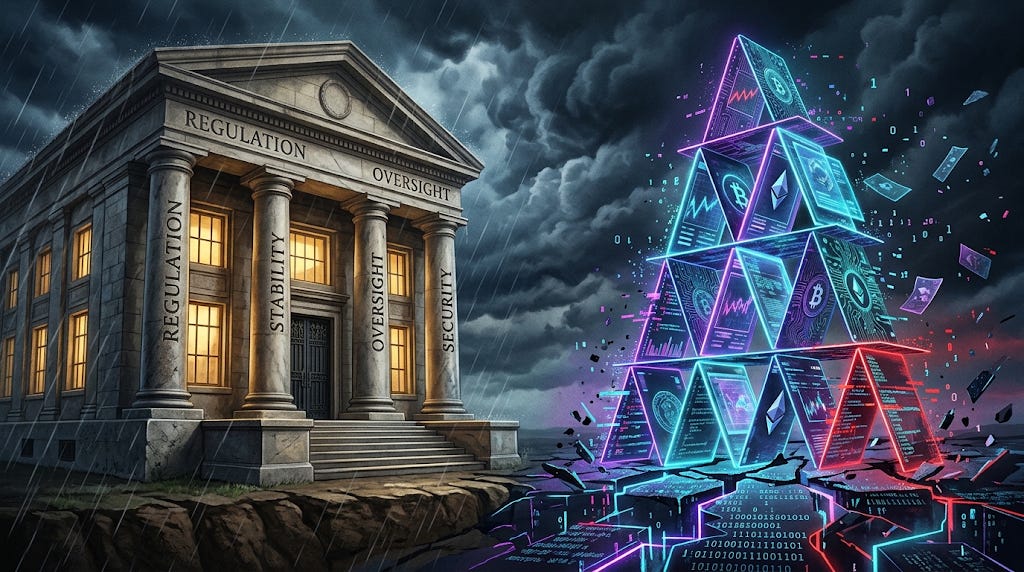
Binance’s recent breach is another warning sign for institutional capital. A company operating as a global custodian cannot continue to run with the internal risk controls of a growth-stage software startup. Without independent statutory oversight, segregated third-party custody, and stress-tested capital adequacy requirements, market participants remain exposed to the reality that in an unhedged crisis, Binance’s balance sheet is only as strong as its next public relations statement.
The resilience of established markets once again underscores the value of a rigorous controls framework, often answering rigorous regulation. Those were forged through past crises and carry higher compliance costs that compress margins; it makes an undeniable case for the stability and investor protection that traditional venues provide.